Search by Topic
In Problem-Attic, you can search for questions by topic. This can speed up selection because you don’t have to navigate through the database looking for specific categories. Also, because your searches are saved automatically, you can use this feature to set up a small customized database, which has the categories you select from most often.
To do a search, click the Select tab, then click the Search by Topic button.

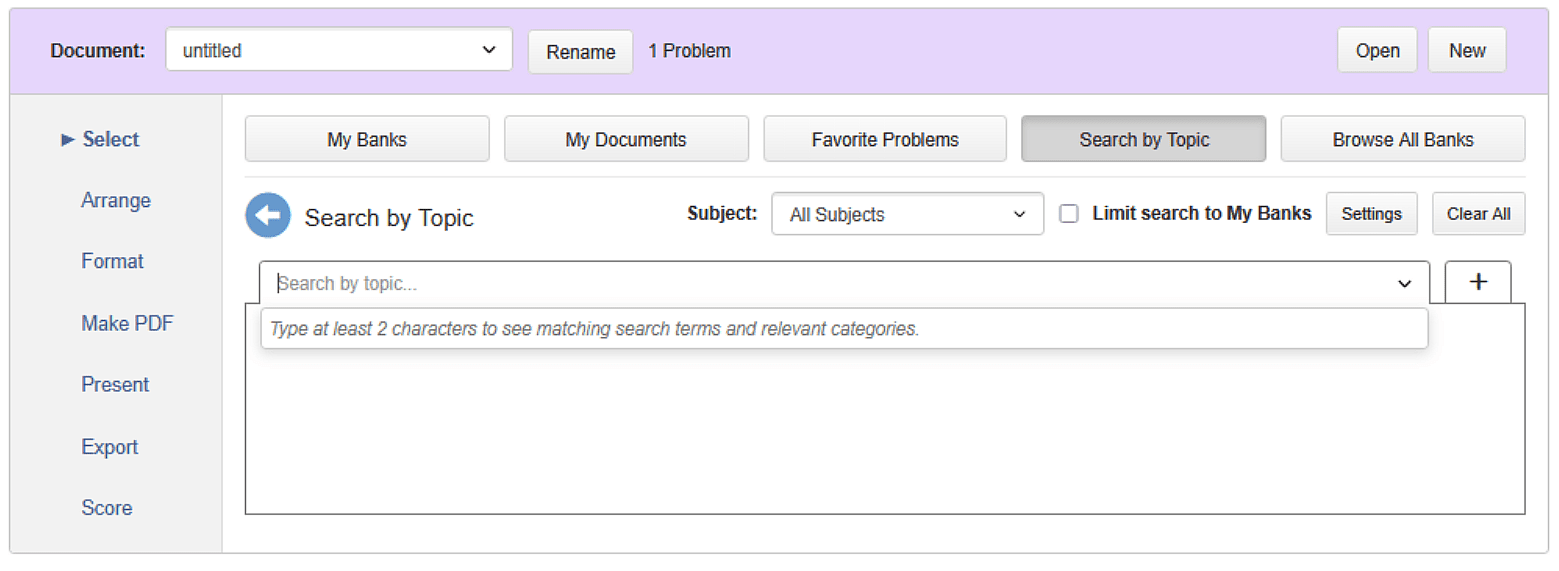
Click in the search field and start typing the letters for a topic or keyword. A list of matching words will appear. To narrow the search, type more letters, or press Space and start typing a related term. Press Enter when you are ready to get a list of categories that contain the matching words.
Note: it is not necessary to type whole words or to start with the first letter. You can type partial words or any fragment of a search term.
Here is an example of a search for “simplify polynomial”:
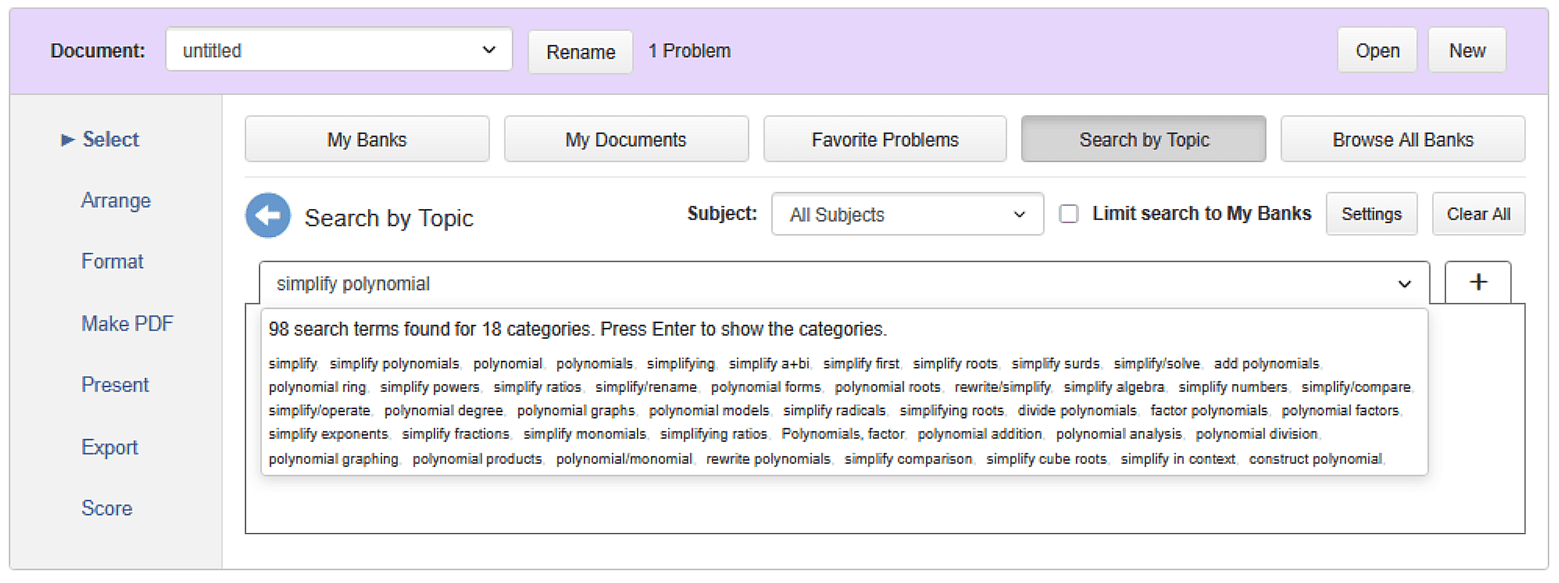
You can see all the terms that match with either “simplify” or “polynomial”. This is meant to give you a general idea of how the database categories have been tagged with keywords. The actual number of returned categories will be smaller. When you press the Enter key, Problem-Attic eliminates the redundant tags and peforms other search logic.
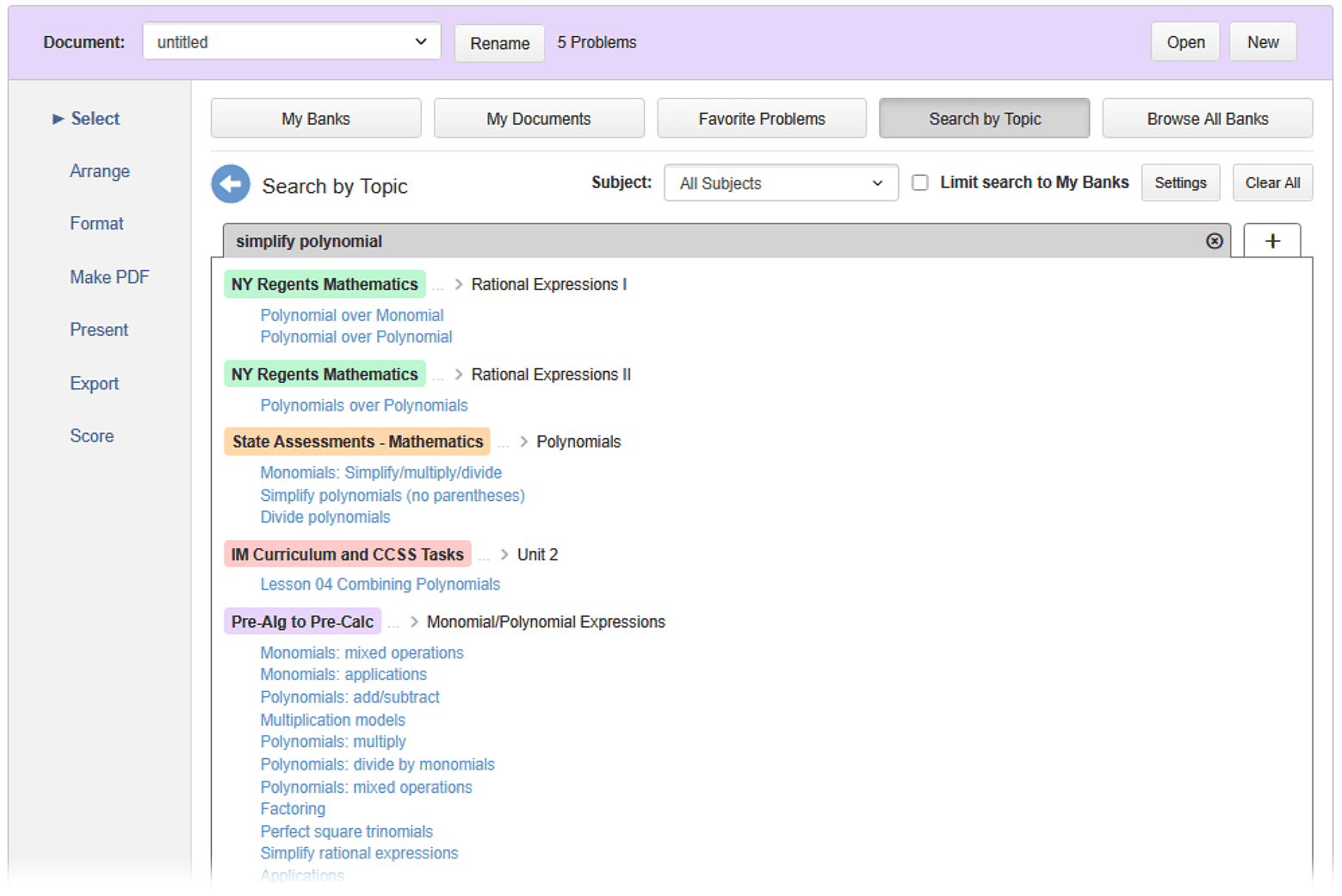
Search by Topic always returns categories of questions. This has certain advantages. First, it’s very efficient, because Problem-Attic’s database is already organized around specific topics and standards. Second, it helps you avoid “false matches” that come from the text of individual questions. (Imagine how many questions would get returned if you searched for “fraction” or “explain your answer”.) Third, it shows the search results in context, so you’ll know where to look for related questions.
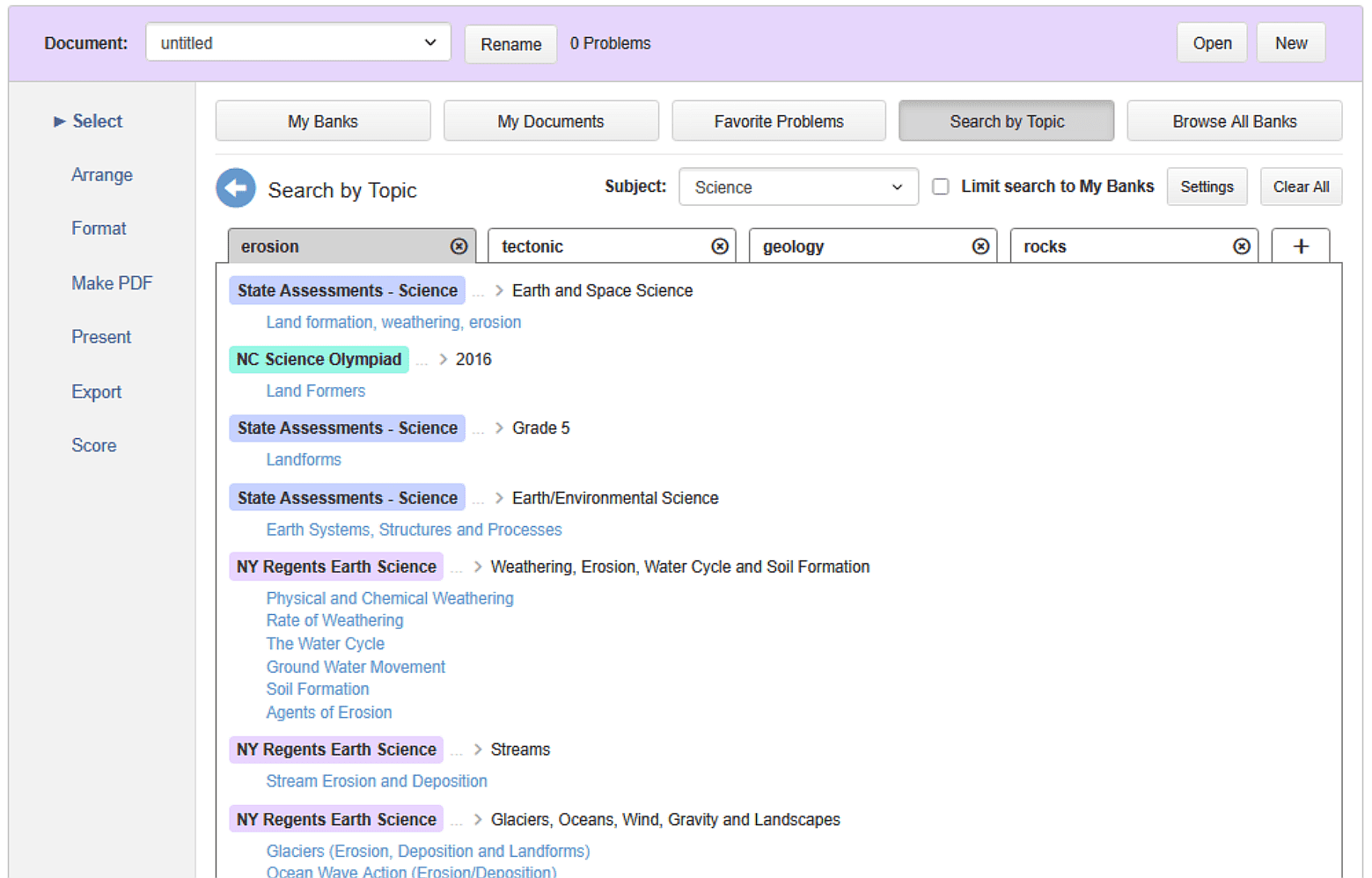
You will notice that search results are tabbed. This means you can click + to open a new tab and do another search. In fact, you can do up to six searches, and Problem-Attic will remember them. This gives you a way to access the categories you use most often or want to return to in the near future, such as for a review worksheet or exam. Effectively, you’re building a small custom database with multiple search tabs. Of course, you can close tabs that you’re done with by clicking ⓧ, and then do a new search if you like.
Here is a search page with multiple tabs for Earth Science topics:
Additional Notes:
-
On the search page, you add problems to your document in the normal way. Drill down into categories and click on problem thumbnails, or use the Add button. However, it’s important to understand that you’re not browsing through categories in their original location. The returned list of categories functions like your own custom bank, and the Navigation Panel can be used to go from one category to the next.
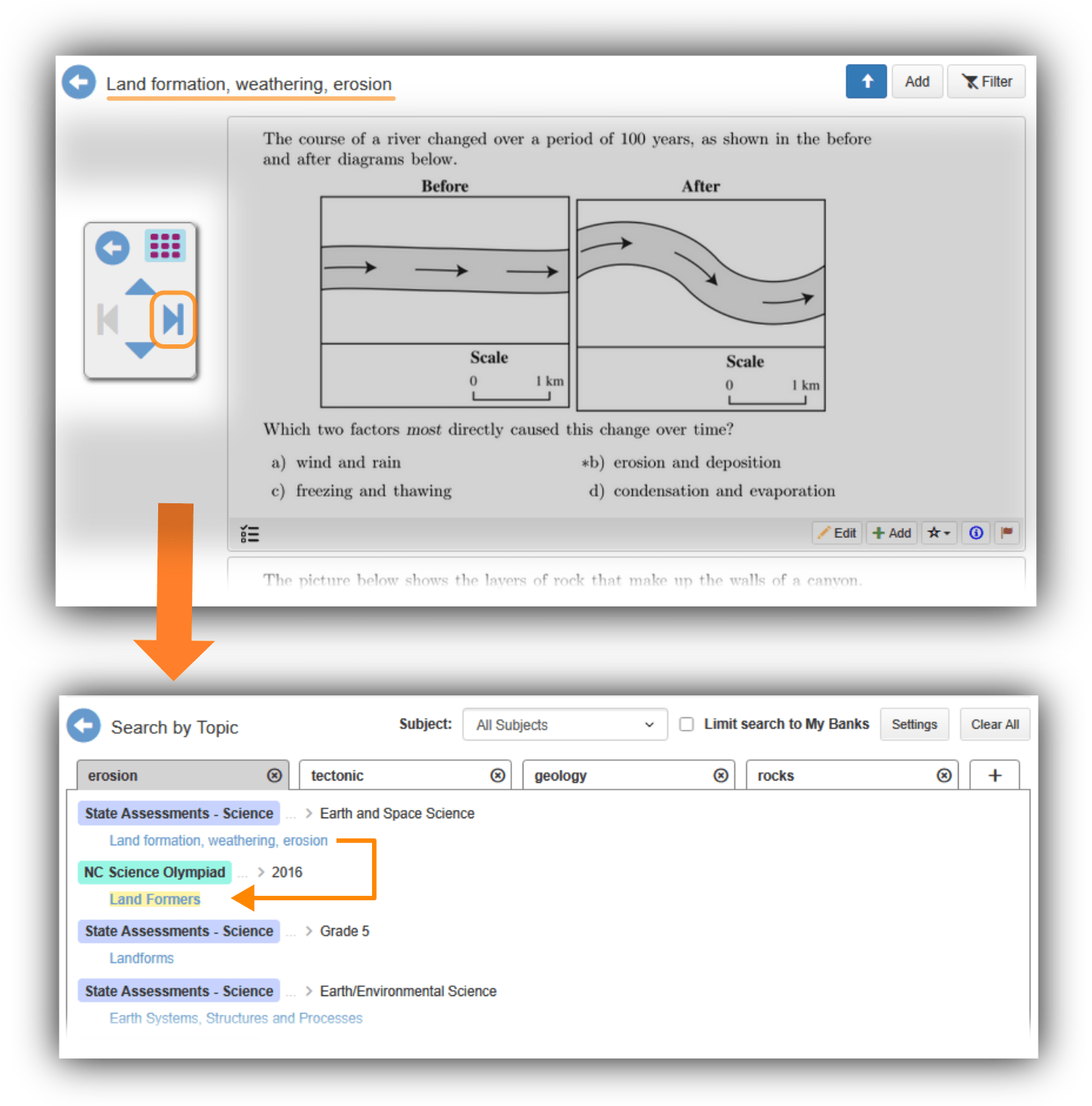
For information about the Navigation Panel or about the right-click option for selecting problems at random, see this shortcuts page.
-
If you find a problem you like and want to explore the bank that it came from, click the "i" button on the problem thumbnail. You will see a link that takes you to the original location of the category in the database.
-
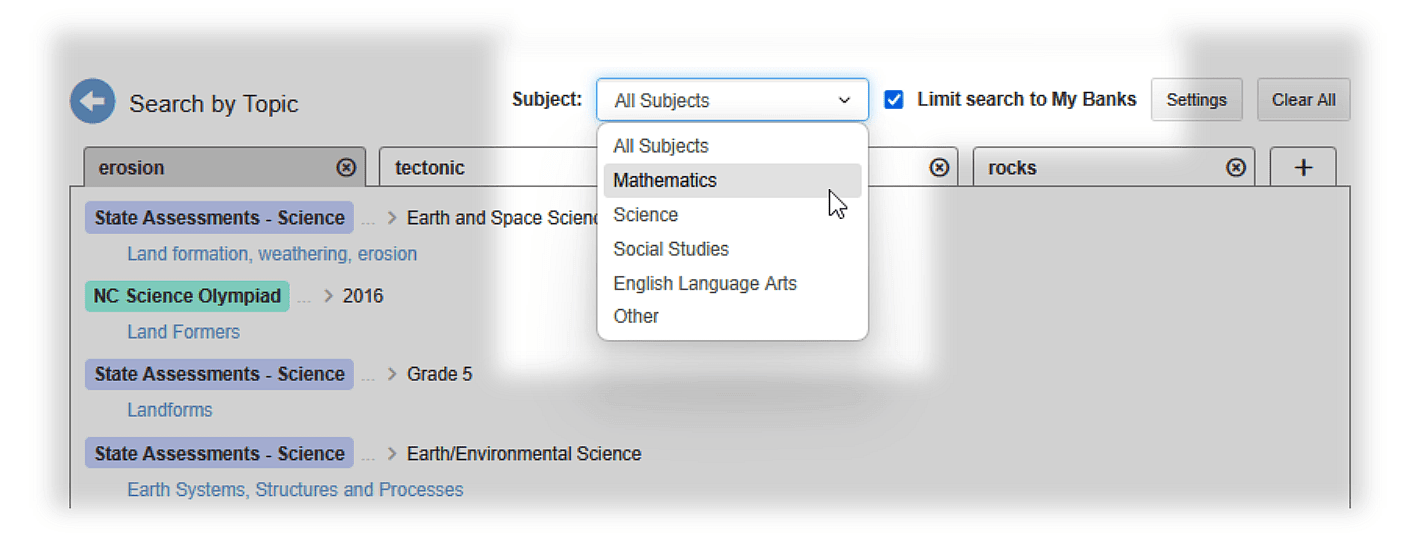
You can broadly narrow your search to the four main subject areas (Math, Science, Social Studies, Language Arts, as well as "Other"), with the Subject dropdown at the top. Note that when a subject is selected it will apply only to future searches. It will not modify any searches that you have already done.
-
If you want to only return categories from the banks that you have added, check the Limit search to My Banks box, as shown above.
-
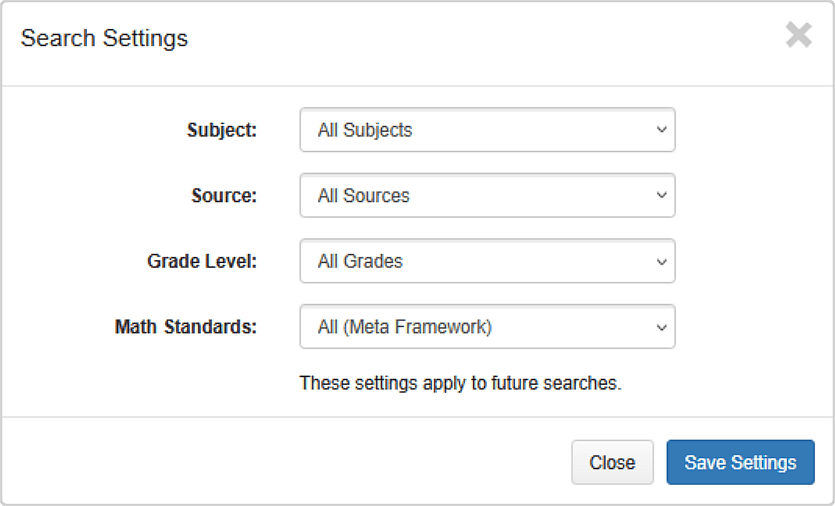
To narrow your search results further, click the Settings button. You can limit the results by grade level and source. (The option called “Math Standards” applies only to the original questions which come with a subscription.)
-
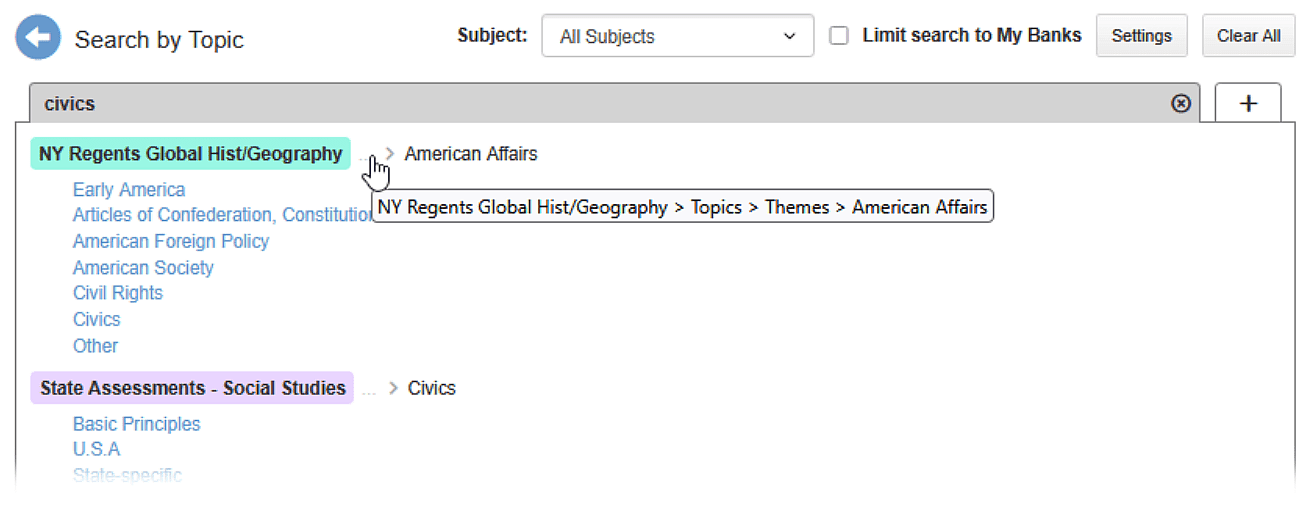
By default, when categories are returned by a search, the category's parent bank and its direct parent level are returned to give context of the category that contains problems. If you wish to see the full context (all intermediate organizational levels) of the category up to its parent bank, simply hover your cursor anywhere on the line above the category and the full context will be shown.
Technical Details
Here are some details that will help you make best use of Search by Topic.
-
Not every category in Problem-Attic's database can be returned with the search tool. We relied on category descriptions and their parent levels when associating keywords, so periodically released exams do not have keywords associated with them. (Think about how broad the topics would be for "Regents > Exams > Alg1 CC > 2025 > August".)
-
The search tool uses a form of tokenization of the search string to match as many relevant categories as possible. When a search query contains spaces, it is split into sub-queries. and the search tool first matches each sub-query to all the possible keywords that contain the sub-query. The returned list of categories are those that have been tagged with keywords that match ALL of the sub-query matches.
We have recently overhauled our search tool to cover 10,000 unique categories and over 15,000 unique search terms and phrases. This totals over 245,000 unique problems, or about 60% of the entire Problem-Attic database that now has search terms associated with them.
We welcome your feedback about the search tool. If you notice missing terms or it’s not showing the categories you’d expect, please write to us at support@problem-attic.com. We want the search tool to produce reliable results and save you time!